
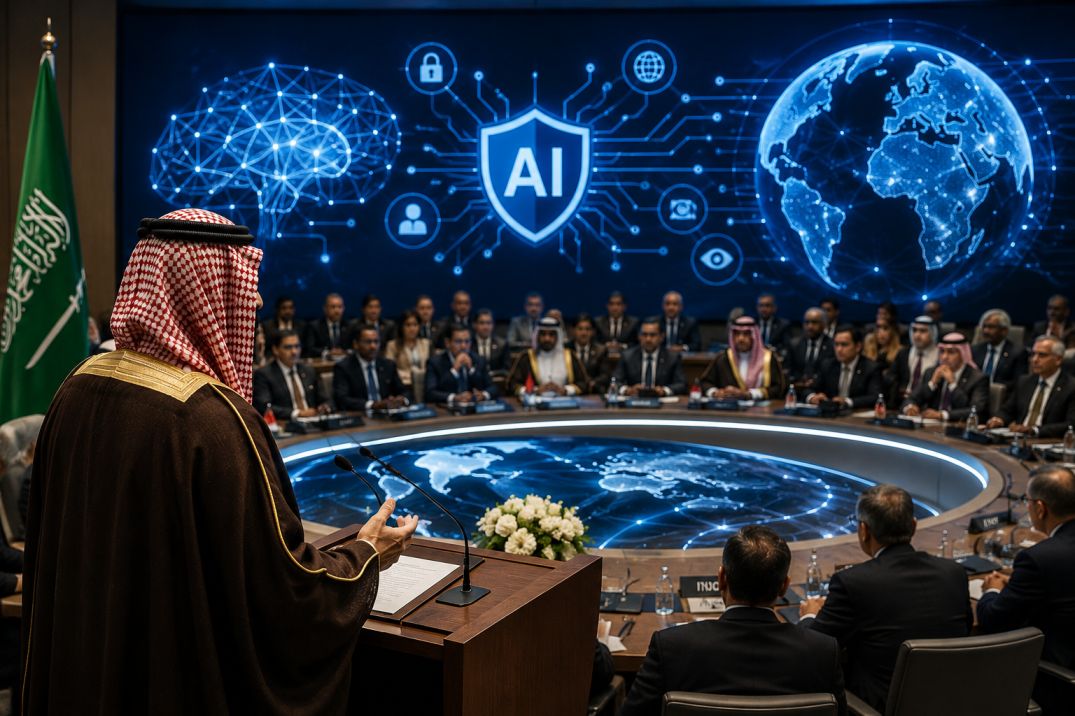
Saudi Arabia has urged the global community to enhance international collaboration in order to prevent terrorist groups from taking advantage of artificial intelligence and other emerging technologies. This call to action was made by Abdulaziz Alwasil, Saudi Arabia’s Permanent Representative to the United Nations, during a session on strategic capacity building at the UN General Assembly. Alwasil stressed the importance of nations sharing knowledge, bolstering their own national capabilities, and investing in sustainable capacity-building initiatives to address the evolving nature of security threats.
Alwasil highlighted that the rapid advancement in technology presents new avenues for extremist groups to recruit, spread their ideologies, fund operations, and orchestrate attacks. He pointed to Yemen as a critical region where terrorist entities, including the Houthi militia and Al-Qaeda, are leveraging technologies like drones. According to Alwasil, governments must enhance their preparedness to keep pace with the increasingly sophisticated tactics employed by these terrorist networks.
The Saudi representative emphasized that counterterrorism strategies must extend beyond mere military and security measures. He advocated for the establishment of robust institutions, modern legal frameworks, international cooperation, and continuous investment in both human and technical expertise to effectively combat terrorism and violent extremism. Alwasil also noted that capacity-building initiatives should be customized to meet the specific needs and priorities of individual nations, working closely with local governments to ensure enduring success.
Saudi Arabia’s significant contributions to global counterterrorism efforts were also highlighted by Alwasil. He noted the Kingdom’s instrumental role in founding the United Nations Counter-Terrorism Centre in 2011 and its financial support of $110 million to help member states enforce the UN Global Counter-Terrorism Strategy. Saudi Arabia remains actively involved in various initiatives such as the Global Counterterrorism Forum, the Global Coalition to Defeat Daesh, and the Islamic Military Counter Terrorism Coalition. The establishment of the Global Center for Combating Extremist Ideology, known as Etidal, further demonstrates the Kingdom’s commitment, as it employs advanced technology to track extremist content and counter online propaganda.
Moreover, Alwasil highlighted Saudi Arabia’s ongoing efforts to support Yemen’s internationally recognized government by strengthening its security institutions in collaboration with local authorities. These initiatives have reportedly improved the detection and disruption of financial and logistical networks that support terrorist groups, while also preventing the transfer of advanced technology and military capabilities to extremists. According to Alwasil, these efforts have contributed to increased security and stability by limiting the potential for terrorist organizations to exploit instability and expand their operations.
