
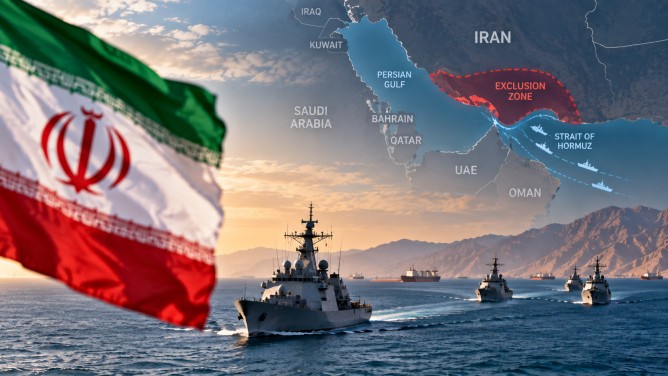
In a recent move, Iran has announced its intention to create an “exclusion zone” near the Strait of Hormuz, a crucial passage for global oil and gas transport. This zone would be implemented to monitor and potentially sanction vessels deemed to be trying to navigate through this strategically pivotal waterway. Mohsen Rezaei, the newly appointed head of Iran’s Supreme National Security Council, indicated that the zone would stretch from the vicinity of the U.S. naval blockade towards the Strait of Hormuz and into the Arabian Gulf. Rezaei mentioned that ships identified as entering this zone with plans to cross the strait might find themselves on an Iranian sanctions list.
The announcement comes amidst heightened tensions following a significant escalation in hostilities. The situation intensified after a U.S. military strike targeted three Iranian oil tankers in response to Iran’s launch of ballistic missiles aimed at U.S. warships. Furthermore, Iran has claimed to have hit an unmanned U.S. vessel that attempted to enter the strait, though this assertion has been denied by the U.S. military.
The Strait of Hormuz remains a vital artery for the transport of oil and gas worldwide, and any potential disruptions in this area have significant implications for global energy prices and economic stability. In response to the ongoing conflict, the United States has reinforced its naval presence to maintain a blockade of Iranian ports, aiming to thwart Tehran’s efforts to export its oil. Concurrently, Washington has ramped up economic sanctions on Iran, particularly after diplomatic negotiations between the two nations broke down.
Despite the strained relations, Mohsen Rezaei emphasized that Iran remains open to diplomatic solutions, although it seeks firmer assurances in any prospective deals. Talks between the U.S. and Iran have reached an impasse, with both parties continuing to accuse each other of various violations. Nonetheless, U.S. officials report that substantial quantities of oil continue to transit through the Strait of Hormuz, facilitated by naval protection and alternative pipeline routes in the region.
