
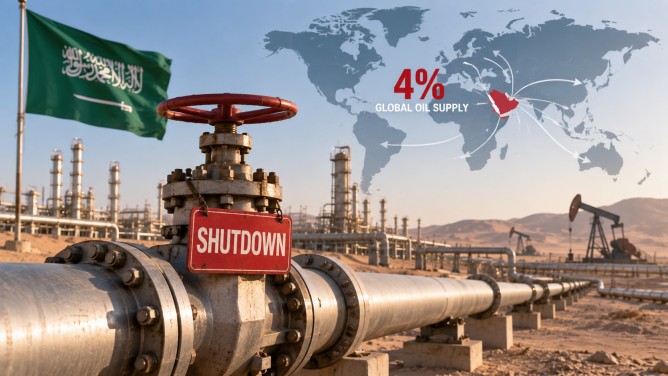
The recent attack that prompted Saudi Arabia to temporarily close its crucial East-West oil pipeline has sparked worries about the stability of global oil supplies. The situation is compounded by the increasing presence of Iran-backed Houthi forces along Yemen’s Red Sea coast, which threatens to further disrupt regional oil shipments. The Houthis have expanded their territorial control near the Red Sea and close to the Bab el-Mandeb Strait, a significant maritime route linking the Red Sea with the Gulf of Aden, raising alarm over the security of oil transportation in the region.
In response to the attack on September 11, Saudi Arabia shut down its 1,200-kilometer East-West pipeline the following day as a precaution. This pipeline plays a vital role in the kingdom’s oil logistics, allowing the transport of crude from eastern oil fields to the Red Sea. This route serves as a crucial alternative for Saudi oil exports, especially when passage through the Strait of Hormuz faces disruptions. The recent increase in exports through Red Sea facilities was a strategic move by Saudi Arabia after the Strait of Hormuz experienced significant challenges amid tensions between the United States and Iran.
The market is on edge as experts warn that a long-term closure of this pipeline could significantly reduce the amount of oil available on global markets. The fear is intensified as Brent crude prices have already surpassed $100 a barrel amid escalating Middle Eastern tensions. If both the Strait of Hormuz and the Bab el-Mandeb Strait experience ongoing disruptions, the impact could be far-reaching, affecting global energy supplies, increasing shipping costs, and potentially driving crude prices even higher.
An increase in oil prices could lead to inflation across major economies, as higher costs for fuel, transportation, and production ripple through various sectors. Nations heavily dependent on imported energy might encounter additional stress on their trade balances and currency values. The length of the Saudi pipeline’s shutdown and the overall security situation surrounding the Red Sea and the Strait of Hormuz will be critical in assessing the potential impact on global oil supplies and energy markets.
